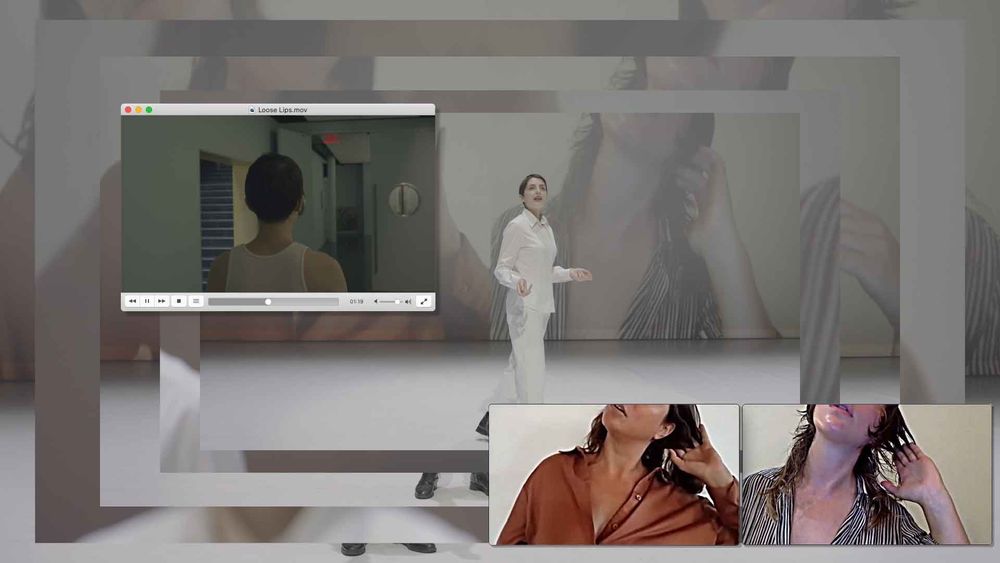
Alexa Echoes
Pohan Amanda TurnerAlexa Echoes recasts the relationship between cultural movements and commercial technologies through the history of women’s devocalization and disembodiment. It begins with mythical Greek figures, such as Echo, and leads up to Amazon’s smart speaker and digital voice-based assistant Alexa.
Afro Algorithms
Anatola ArabaThis 3D-animated short film in the Afrofuturist genre explores the topics of AI and bias. In a distant future, a bot named Aero is inaugurated as the world's first AI ruler. But Aero soon learns that important worldviews are missing from her databank, including the experiences of the historically marginalized and oppressed.
Echoes in My Mouth
Orit Ben ShitritWhen artificial intelligence arrives at machine consciousness, and human memories and traumas can be rewritten or removed, four humans struggle to reach a memory bank in a remote cave. They follow an enchanting siren as they travel into a mysterious world.
Cosas que nunca van a morir (Things That Won’t Die)
Manuela Gutiérrez ArrietaAfter finding videos she uploaded to YouTube when she was a child, Manuela attempts to follow the trail she herself left on the internet. Along the way, she comes across things that even she did not remember about herself. This is a film about childhood, consent, and the way we look at ourselves.
HYSTERESIS
Robert SeidelHYSTERESIS intimately weaves a transformative fabric between Robert Seidels’s projections of abstract drawings and queer performer Tsuki’s vigorous choreography. Using machine learning to mediate these lagged re-presentations, the film intentionally corrupts the AI’s strategies to unveil a frenetic, delicate, flamboyant visual language of hysteria and hysteresis in this historical moment.
The Endless
Yvette GranataThe Endless is a speculative sensory ethnography film generated from AI models in the act of interpreting humans and vice versa. Alien landscapes and 3D models are constructed through the eyes of a machine roaming through an unknown human-machine culture.
WENN DIE WELT ZU ENDE GEHT, WERDE ICH DICH GELIEBT HABEN (When the World Comes to an End, I Will Have Loved You)
Gloria GammerFollowing a climate catastrophe, Andy uploads themself into the digital afterworld. Even though they have a hard time adapting to the digital world, the omnipresent superintelligence insists that paradise is right here. The film was mainly shot in the metaverse Second Life.
The Ghost in the Machine
In his 1949 critique of Cartesian mind-body dualism, philosopher Gilbert Ryle introduced the idiom “ghost in the machine,” poking fun at the idea that the mind may be a non-physical entity (a ghost) that somehow interacts with the mechanical body (the machine). It has since been used to describe the nature of machine learning or artificial intelligence.
Machine learning algorithms are fed by the massive and ever-changing pools of information accessible through a global network of interconnected computers, servers, and other devices that constitute the internet. And thus, AI gains access to vast amounts of data which it then processes to create the outcomes people utilize. But algorithms and the data that feeds them are not neutral. As professor Elisa Celis points out, societal and economic ramifications manifest at the interface of computation and machine learning, specifically regarding fairness and diversity.
The works that make up this program are tethered, in one way or another, to the host of knowledges that is the internet. They raise concerns around unrestricted access at a young age, the internet as an archive, as well as Amazon’s Alexa and AI. The filmmakers expose some of the cultural, gendered, historical, and racial biases now implicit on these platforms as the ghost in the machine. Amanda Turner Pohan, Anatola Araba, Gloria Gammer, Orit Ben Shitrit, Manuela Gutiérrez Arrieta, Robert Seidel, and Yvette Granata reconsider the present moment and the potential shortcomings of a phantom-led future.
Orit Ben Shitrit is a transdisciplinary visual artist, experimental filmmaker, choreographer, and educator. In her moving image work, she utilizes movement and bodies to implicate the powers that be: their mechanisms of domination, their effect, and their potential for violence. Orit's work has been exhibited across the US and internationally.
Manuela Gutiérrez Arrieta’s artistic work began at the age of 15 when she started to obsessively capture her family. She made her first two short films, Abismo and El mar lleva tu Nombre, as a teenager. She currently studies Documentary at the ECAM film school in Madrid, where she discovered her interest in documentary, experimental cinema, and video art. Cosas que no van a morir was selected by the Cantabrian Film Commission for Cantabria en corto 2022.
Pohan Amanda Turner's interdisciplinary practice uses the body’s complicated relationship to technology as source material. Through sculpture, video, sound, text, and performance, Pohan's practice is curious about the ways in which bodies are shaped, metabolized, and surveilled by digital technologies.
Yvette Granata is a media artist based in Detroit. She is Assistant Professor at the University of Michigan in the Department of Film, Television, and Media and the Digital Studies Institute. She works across multiple media including video art, animation, VR, and interactive installations. She sometimes designs hypothetical technological systems.
Robert Seidel is interested in pushing the boundaries of abstracted beauty through cinematographic approaches, as well as ones drawn from science & technology. His award-winning projections, installations, and experimental films have been shown in numerous international festivals, art spaces, and museums.
Gloria Gammer is a film director, screenwriter and media artist based in Berlin and Linz . Her work is concerned with the relationships between humans and between human and non-human others, often regarding imaginations of the future.