Return of the Bright Night
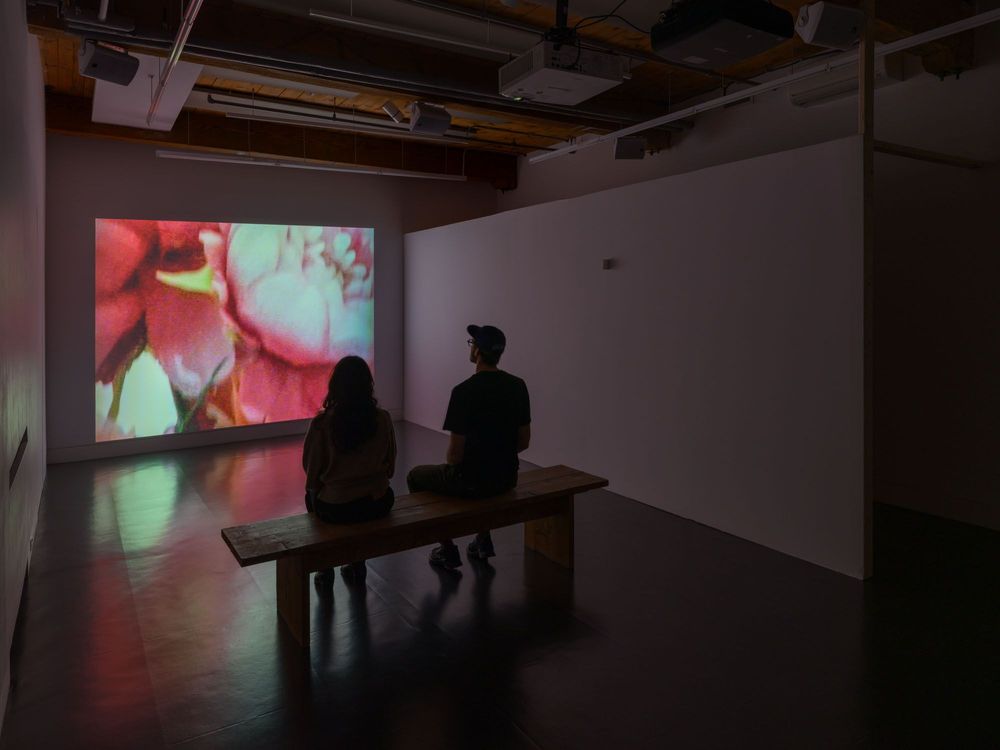
Sophie SabetReturn of the Bright Night presented at the Bachir/Yerex Presentation space during the 2026 Images Festival. Documentation by Darren Rigo.
Return of the Bright Night
Return of the Bright Night presented at the Bachir/Yerex Presentation space during the 2026 Images Festival. Documentation by Darren Rigo.
Return of the Bright Night
Return of the Bright Night presented at the Bachir/Yerex Presentation space during the 2026 Images Festival. Documentation by Darren Rigo.
Return of the Bright Night
Return of the Bright Night presented at the Bachir/Yerex Presentation space during the 2026 Images Festival. Documentation by Darren Rigo.
Return of the Bright Night
Return of the Bright Night presented at the Bachir/Yerex Presentation space during the 2026 Images Festival. Documentation by Darren Rigo.
Return of the Bright Night
Originating from Sophie Sabet’s short film of the same name, this exhibition revisits a moment of political and familial rupture to investigate how structures of power in political crises cause residual alienation across temporalities, lineages, and geographies. Return of the Bright Night mines the gaps and fissures within memories and migration, tracing the past in order to negotiate the present.
Glimmers of a Revolution: Sophie Sabet's Return of the Bright Night
Sara Saljoughi
A hand holds a black-and-white photograph of a male figure. The hand flexes, bends, warps the photograph, exposes it to light. Throughout the film we return to this image, in slightly different forms. Its continual return makes it more resonant, as does its proximity to untranslated pages of Persian prose, and to a human finger pointing diagonally across the image (to what?). Through repetition and ambiguity the film questions the relationship between personal experiences and collective histories—themes that are important to Iranian-Canadian artist Sophie Sabet's entire body of work and which emerge here through an engagement with her family's experience of the 1979 Iranian Revolution. The man in the photograph is the filmmaker's maternal uncle, an activist who was killed for his political activities. Part of Sabet's project is to unearth information about what really happened to him. The manual manipulation of his photo aptly encapsulates Sabet's exploration of her family's history against the backdrop of the Revolution. It seeks to illuminate the desire to fill in historical gaps, to trace the after effects and violent displacements of history, even while knowing they can never be complete.
The filmmaker's desire to learn more about her uncle's political activities and his execution uses the camera to perform a self-ethnography. It is impossible to know the truth of what happened to her uncle, and that gap reveals the stories that proliferate from mere glimmers. The fragments of what Sabet knows and learns are distilled directly from her mother's words, but also through second- and third-hand accounts from Sabet's aunts transmitted via her mother. The distorted photograph of her late uncle moves and warps while being bent between two soft-backed mirrors; his story provides a mirror for reflecting on Sabet's relationship to this family history. Each member looks into this mirror, projecting their own fears, desires, and questions against this obscured history.
As with Sabet's The Perfect Day (2020) and Since We Last Spoke (2016), Return of the Bright Night probes the past with respect for the lived experience of her relatives. The first minute of the film foregrounds her mother's recorded voice against the hum of an engine. The screen is largely a black frame, broken temporarily by a prism of grey light and what appears like the snow of TV static. We hear the artist's mother saying she never had the strength to listen to the truth, because it was very difficult for her to hear what actually happened. Sabet's mother pushes past her difficulty for the sake of her daughter's work: "But I thought since you want to document this, it's best I speak with the aunts to know what really happened." This maternal sacrifice of comfort fits in a long tradition of mother-daughter films, such as Mona Hatoum's Measures of Distance (1988), that cross normative limits of disclosure and knowing.
Though Return of the Bright Night features Sabet in conversation with her mother, the film extends beyond their relationship, using lo-fi strategies of distortion and extreme close-ups to create an assemblage of the testimonies, nightmares, personal photographs, and news images that are the materials of fragmented memory. The mother's account of her experiences reaches from Iran to Canada, and to the experiences of different members of Sabet's family. We listen to a conversation between mother and daughter that bears traces of their migration. Speaking in Persian, a few English words pop up in their speech. Revolution and displacement leave their marks on Iranian-Canadian speech. What was left on the body and the psyche must be filtered—an accounting for oneself and one's culture translated in part in the idiom of the Western imperial imaginary. A single word like "torture" punctures the soft lilt of Persian and condenses abstract images of horror. The lingua franca for state violence steps in to connote what remains unseen but known and felt.
Sabet captures her mother's face in extreme close-up as she drives and answers questions. The tight framing, bringing us close enough to see the skin's texture, speaks to the filmmaker's desire to know, to get closer to the truth of this story. When Sabet's mother says "safe" in English, it is the intimate setting of being in a car with her daughter that amplifies how the mother means the word. To be "safe" speaks not to the rhetorical promise of migration to a place like Canada, but to the everyday: Sabet's mother can sleep only if she knows her (other) child is home and "safe." In keeping with the film's general register, we don't know all the details or exactly why the mother needs this, only that her admission offers a glimmer of something obscured. If she sleeps comforted by this proximity, another fragmented conversation elsewhere in the film tells of the nightmares that keep her awake. Visions of what might have happened to her brother during the Revolution. Torture. The nightmare is multiscale: it invokes both the abstract enormity of political violence and its horrific figuration in the intimacy of dream images.
In the final shots of the film, the titular radiance is the shining sun in a foggy, overcast sky. It appears over the horizon, summoning a new day, like the revolutionary energy that coursed across the Iranian social and political landscape in the 1970s. Though the resulting theocratic state was far from what many imagined and hoped for, it is undeniable that hope drew millions of Iranians, including Sabet's uncle, together in solidarity. It is this enduring truth, the utopian quality of Iran's revolutionary moment, that makes the ensuing reactionary violence so difficult to bear. The warm sun, steady and insistent, set against the fog and grey. To return to the bright night, then, is to long for that buoyant, hopeful energy and to imagine its trajectory otherwise. Yet the film doesn't resolve either Sabet's desire to know, or our desire to have a story spelled out for us. Instead, the distance from a "bright night" remains until the very end. The film suggests that the events that become family lore are better understood as partial narratives that affect the entire family for generations to come. As the camera frames the sterile hallway of a suburban condo, or the bleak and emptied-out landscape of the Canadian winter, we think of the distance from the collective, from that bright night. We dream of its return because we can feel it through the fog, insisting.
Please join us for a reception followed by a tour with artist Sophie Sabet on Saturday, April 11, 2026 from 11:00 a.m. - 12:30 p.m.
April 25, 2026
Tuesday – Wednesday
12:00 p.m. to 5:00 p.m.
Thursday – Friday
12:00 p.m. to 6:00 p.m.
Saturday
12:00 p.m. to 5:00 p.m.
440-401 Richmond St West Toronto, ON M5V 3A8
Street level entrance, ramp, elevator, automatic doors, door width 34”. Gender neutral accessible (32”+) washrooms, stall, no automatic door. No accessible parking on site. To access Bachir/Yerex, use either the stairs or elevator to the 4th floor.
For a map to Bachir/Yerex Presentation Space, click here






