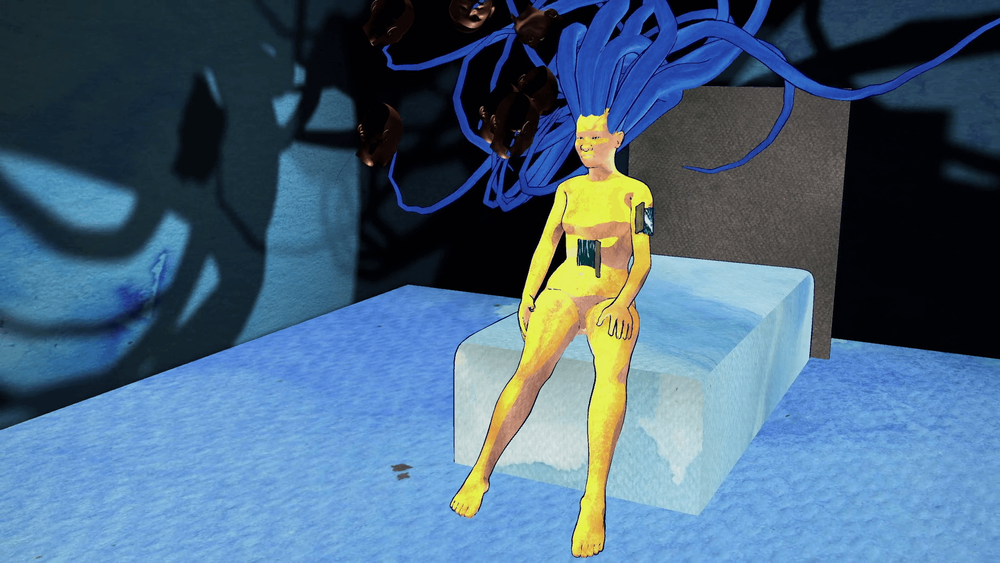
100 Ghosts
Noncedo KhumaloA woman awakes to mysterious sounds—and confronts an astonishing, surreal world summoned forth by her innermost fears.
The Season of Burning Things
Asmaa Jama, Gouled AhmedUnfolding from the creators’ perspectives in the Somali diaspora, the piece takes the lead from East African mythos and Islamic imagery to explore mythmaking, and Blackness; a ‘generation of ghosts’ and the transient spirit.
Démayé
Simone Lagrand , KlēloDémayé means to unravel. The conversation about sexuality, pleasure, desire, and eroticism is tied to the throat, even nowadays. This film is a sort of “bendémaré”: a ritual bath in Martinique. It is an invitation to rethink sexuality in order to remedy what causes the body and the soul to remain in situations to which they don’t belong.
No Archive Can Restore You
Onyeka IgweTaking its title from the 2018 Julietta Singh book, No Archive Can Restore You depicts the spatial configuration of a colonial archive, which lies just out of view, in the heart of the Lagosian cityscape. The films housed in this building are hard to view because of their condition, but perhaps also because people do not want to see them. They reveal a colonial residue that is echoed in walls of the building itself.
In Our Being / Sa Aming Pagkatao
Ghislan Timm , Jann Earl Q. MadariagaAn experimental autobiographical film that converges two queer people of colour’s perspectives from the Philippines and Canada into one narrative body. Body parts (mouths, chests, arms, eyes) filter in evanescent motion between frames, referencing early cinema while eerily anticipating an uncertain future. As a cross-continental virtual production, the film explores, through collage-making and performance art, themes of alienation, queerness, Afrofuturism, and the flux of self-concept.
The Fourfold
Alisi TelengutBased on ancient animistic beliefs and shamanic rituals in Mongolia and Siberia, this is an exploration of Indigenous worldview and wisdom. Against a backdrop of modern existential crisis and human-induced rapid environmental change, there is a necessity to reclaim the ideas of animism for planetary health and non-human materialities.
Adey and Mom
nala haileselassieThe artist and her mother in conversation about motherhood, memory, and kinship, on Mother’s Day in 2022.
Living Ghostliness
“...What holds me together, is the knowledge that I cannot resist seeing; what holds me is the real look of things. If I see someone I see the ghost of them, the air around them, and where they’ve been. If I see the city, I see its living ghostliness…"
–Dionne Brand, The Map to the Door of No Return
Living Ghostliness meditates on a collection of moving images that orbit mythmaking, archives, intimacy, and more-than-human kinship against the insidious terrain of extra/ordinary violence. Inspired by Brand’s generative musing on sensing the living ghostliness of people, places, and things, these experimental films contend with the weight of being, through city landscapes and river currents, body movement and the erotic, archival footage and candid conversation. The themes of these films evoke an attentiveness to the historical air that surrounds our spirits, homes, and natural environments. The living ghost invites the viewer to reckon with our contentious pasts and presents, and conjures up the desire to be and stay alive, in all its complexity.
Please join us for a conversation with the filmmakers following the screening.
Alisi Telengut is a Canadian artist of Mongolian origin. She creates animation frame-by-frame under the camera with mixed media to generate movement and explore handmade and painterly visuals for her films. Alisi is a Canadian Screen Award nominee and a Québec Cinéma Awards – Prix Iris winner in Best Animated Film. Her work received multiple international awards and nominations, including Best Short Film at the Stockholm Film Festival, Best Animated Film at the Mammoth Lakes Film Festival and the Brussels Independent Film Festival, as well as a Jury Award at the Aspen Shortsfest.
Asmaa Jama is a Somali artist and poet based in Bristol. In 2021, Jama was shortlisted for the Wasafiri Writing Prize and long-listed for the National Poetry Competition. Jama is a Cave Canem Fellow.
Ghislan Timm is an experimental filmmaker and visual artist based in Tkaronto. They are currently studying Integrated Media at OCAD University and have shown works both locally and internationally. They are influenced by their Afro-Caribbean heritage, Afrofuturism, sound, and cinema, frequently appropriating archival film and imagery to create collages and shape non-linear narratives that reflect on their multicultural queer identity, mythologies, and romanticization of home and homecoming.
Gouled Abdishakour Ahmed is an Addis Ababa–based Somali visual artist, stylist, costume designer, and writer. Their work explores themes of memory and belonging through the lens of self-portrait photography and self-fashioning. Gouled’s work deals with the notion of futurity, and is heavily aimed at envisioning new and equitable aesthetic futures for the Horn of Africa.
Klēlo is a multidisciplinary artist whose sound and visual microcosms explore the heart of our ma(g)ma: intimate and collective memory.
Jann Madariaga is a Filipino multimedia-artist based in Cavite, Philippines. He creates visual art through digital means of design, film, photography, and illustrations. His work predominantly involves using the human form to tell melancholic stories of the human experience.
Onyeka Igwe is an artist and researcher working between cinema and installation, born and based in London. Through her work, Onyeka is animated by the question “how do we live together?”, with particular interest in the ways sensorial, spatial, and non-canonical ways of knowing can provide answers to this question.
nala haileselassie is a multidisciplinary artist from Tkaronto completing her BFA in film studies at Toronto Metropolitan University. Working from the lineage of Black feminist film and experimental documentary, her research is focused on cultural and collective memory, and the relation between the two as a child of migrants. nala looks to rework narratives surrounding diasporic identities through complicating personal archival materials.
Noncedo Khumalo is an animator and filmmaker based in Montreal and raised in Swaziland and South Africa. She is largely interested in making Black queer art that humanizes our future and blends storytelling with the abstract.
Simone Lagrand is a poet, spoken word artist, and creative writing workshop facilitator. Her work is a long conversation with her motherland, Martinique. As a yich déwò (child from abroad) she constantly intends to build a creative biotope which questions her dual relationship with language (Creole and French) through the observation of intimate bonds such as love dialogues, eroticism, and also motherhood. Her poetry uses various media such as embroidery, sonic landscaping, or video. A former resident at Villa Albertine’s program in Miami, she is expecting to start a residency at Tropiques Atrium Scène national in Martinique for 2023.
Sarah Edo is an emerging curator born and based in Toronto. Her work thinks through Black queer diaspora, desire, and materiality. Her creative pursuits are guided and grounded by her experiences in community work, collective study, and intentional relation-building. She holds a Masters in Gender Studies and is currently pursuing a PhD in Cultural Studies.
2 Sussex Ave, Toronto, ON M5S 1J5
Please note that for entry to Innis Town Hall, Sussex Drive is closed and inaccessible by car. The sidewalk is open and the entrance remains open. Sidewalk-level entrance, elevator and ramp available, door width 32 inches, no automatic doors. No accessible parking on-site. Four wheelchair accessible seats in the cinema. 15 step-free seats in row 9. Accessible gender-neutral washroom located on the 2nd and 3rd floor.
For a map to Innis Town Hall, click here