Apollo
Tomonari NishikawaNishikawa’s senior thesis film was created with rayograms (placing objects on the film in a darkroom) and a still, 35mm film camera that extended the image into the soundtrack area. The result is a film where the projector reads the image as sound, creating a frenetic aural counterpoint to the graphical images he chose.
Market Street
Tomonari NishikawaA series of frame-by-frame, Super 8mm Sketch Films which Nishikawa made in graduate school in San Francisco paved the way for this commissioned film, which celebrates A Trip Down Market Street (1906) through a vertiginous reinterpretation. Matching disparate shapes from one frame to the next, Nishikawa uses the shapes of the city to pull the viewer with stunning visual propulsion down San Francisco’s main drag.
Clear Blue Sky
Tomonari NishikawaFor this rare video work, Nishikawa replaced the camera lens in front of the sensor with a slit-like opening, mimicking a camera obscura effect. Through this perspective, he turned the summer frolickers of San Francisco’s Washington Square into streaks of light and shadow.
16-18-4
Tomonari NishikawaUsing a 35mm toy photo still camera, which has sixteen lenses, Nishikawa shot the horse races at the Japanese Derby. Shown as a 35mm film, the image is made up of a grid of four shots, repeated across four frames, creating a unique visual rhythm as a portrait of a racecourse.
Lumphini 2552
Tomonari NishikawaAnother film shot on a 35mm still camera, in which the image was used to create the soundtrack. This time, Nishikawa shoots in Lumphini Park in Bangkok, Thailand, where the organic structures of the fauna soften his grid structures, even as his interest in internal image rhythms continuously comes to the fore.
Tokyo - Ebisu
Tomonari NishikawaThe intricate, interwoven train lines of Tokyo were an inspiration to shoot a clockwise trip around the JR Yamanote Line. Nishikawa captures the platforms of the first ten stations, re-exposing the film multiple times. Each take exposed a different section of the platform at a different moment in time, with the combined image amplifying the visual energy of commuting.
Shibuya - Tokyo
Tomonari NishikawaA broken camera and a zealous station manager caused Nishikawa to finish his filmic circumnavigation of the JR Yamanote Line a couple of days later. While using the same grid as the previous film, this time he shot the exits of the final twenty stations from morning to night, capturing the incessant activity surrounding the train lines.
45 7 Broadway
Tomonari NishikawaThe hustle and bustle of Times Square is reinterpreted by Nishikawa through a “three-strip” colour separation technique akin to Technicolor. He filmed each shot three times through red, green, and blue colour filters on black-and-white film and then re-composed the shot on an optical printer. When objects overlap, they reach “full-colour,” but the constant movement ensures the colour never truly resolves.
sound of a million insects, light of a thousand stars
Tomonari NishikawaThe meltdown of the Fukushima Reactor that followed the Tōhoku earthquake in 2011 inspired Nishikawa to bury film in the ground within a few miles of the accident site to see if he could create a visual record of the radiation that had spread across the land. The film is a print of the resulting negative—each scratch a physical trace of interference and decay.
Ten Mornings Ten Evenings and One Horizon
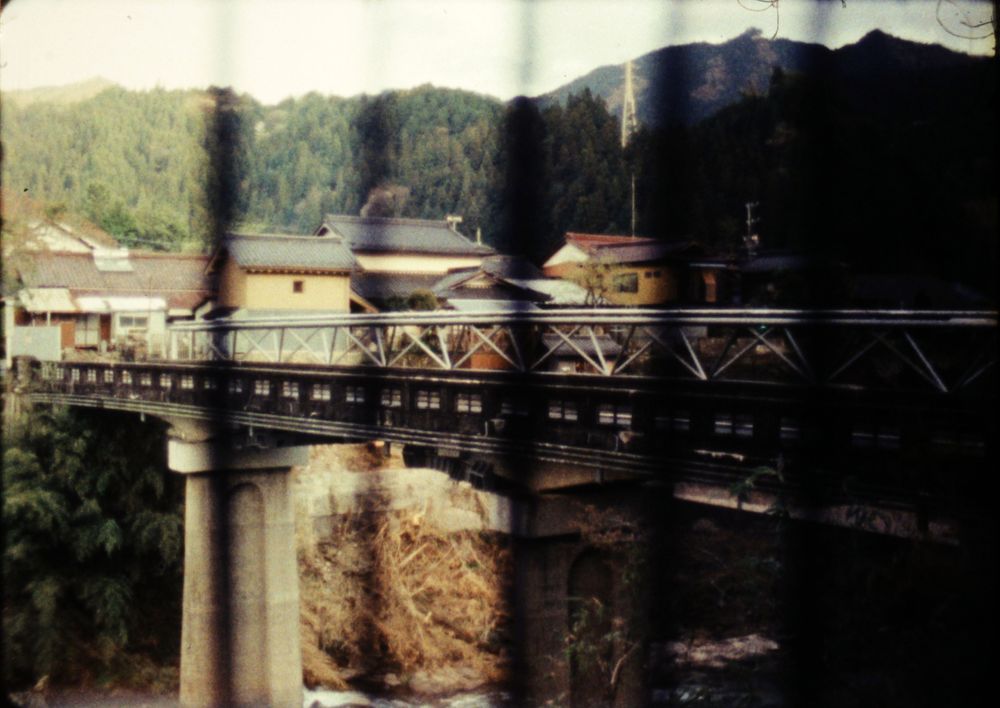
Tomonari NishikawaNishikawa grew up along the Yahagi River, whose bridges are the focus of this film. Each of the bridges is filmed six times during dawn and dusk. As in his previous train films, he masks and re-exposes the film, compositing the final image in-camera from the six takes to make a beautiful portrait of the passage of time in rural Japan.
Amusement Ride
Tomonari NishikawaFlattening the image of a Ferris wheel ride by using a telephoto lens, Nishikawa turns another common public celebration into a surreal, abstract, cinematic adventure.
Light, Noise, Smoke, and Light, Noise, Smoke
Tomonari NishikawaAnother return to the idea of creating sound from the physical image that he first explored in Apollo, Nishikawa filmed fireworks at a summer festival with a Super 16mm camera that extended the image into the soundtrack. Following a strict editing structure of 26 frames, Nishikawa created a rhythmic exploration of a technique that always drew him to new discoveries.
Light Noise Smoke: The Films of Tomonari Nishikawa
Tomonari Nishikawa, who passed away in 2025 at the early age of 56, was a central figure in the generation of experimental filmmakers that emerged in the early part of the 21st century. A wrong turn on his way to a conventional filmmaking career landed him at Binghamton University (New York), a fabled hotbed of the avant-garde, where he reluctantly embraced a new way of filmmaking that he made deeply his own. Key areas of inquiry for him were the elements of the film material itself. He created films where the images transformed into the soundtrack; shot frame-by-frame, sketch films that became compact city symphonies. He also used multiple exposures to build up a larger image from separate spaces and times. His twenty years of filmmaking were too short but deeply impactful, creating simple models of possibility through art and personal example, challenging our expectations of how cinema could be made, and providing us pleasure in both the directness and profoundness of his ideas.
350 King St W, Toronto, ON M5V 3X5
For a map to TIFF Lightbox , click here






