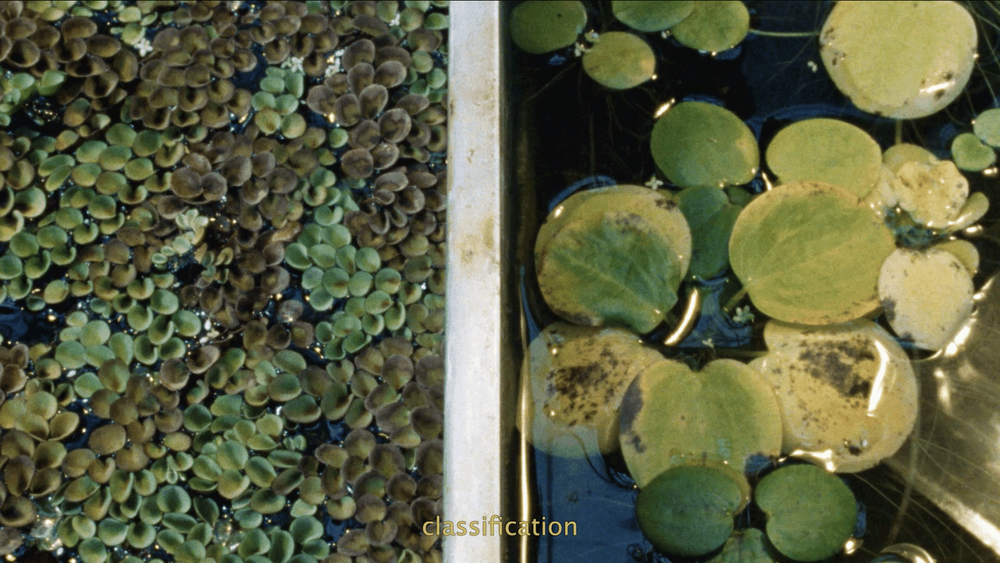
Thoughts on control and care
Eva SwiatkowskiThoughts on control and care examines the power structures of colonial history in the context of botanical gardens. In episodes of stillness and movement, the voice-over repeatedly examines the filmmaker's own clearly structured ideas and definitions of nature and questions the hierarchical systems of botany.
Жвачка (Zhivachka)
Liz AdlerA mother recounts her experiences as a child in Soviet-era Moscow.
Ottu (Eight)
Sandra IgnagniA filmmaker searches for the eight winds of the Mediterranean on the island of Corsica. Using found footage and employing 16mm hand-processing experiments that attempt to expose its ethereal subject, the film brings audiences to abandoned churches, cemeteries, and ravaged beaches in a quest to find meaning in that which is invisible and has neither source nor end.
Ceaseless Translation
Alejandra SaldivarThis film tells the story of a mother's experience of caring for a child with autism. The film is a mix of personal home videos, stock footage, and mixed media animation, emphasizing the role of hands as symbols of care.
To boyhood, I never knew him
Tram Anh NguyenTo boyhood, I never knew him is a short experimental film featuring a distorted poem and archive footage from 2006-2010. Words from a transgender man float to the surface of the screen as the blurry memories play, displaying how only fragments of what is remembered exists.
To Be Seen
Alejandra HarrisonSusana Ruiz is 77-years old and often feels invisible. Through the format of video portrait, the filmmaker explores her grandmother's relationship with presence and visibility.
Afraid of Losing the Echoes
Amel MoyersoenAfraid of Losing the Echoes is an archive film and visual poem calling us to remember the histories and the continued resistance against police violence in Brussels, it is a testament to those who resist and persist.
I didn’t hear the wind echo
One star burning out does not extinguish the light of the constellation. Where many may see separation between the personal and the collective, the student filmmakers included in this program, I didn’t hear the wind echo, create and strengthen connections despite an assumed polarity. Through the use of mixed media animation, archival footage, as well as the essay film format, these films act as stars in a constellation—a constellation that illuminates the film space with a more holistic, well-rounded approach to storytelling that refuses a singular perspective or narrative. One does not exist without the other. Individually, they are points in the sky. One is no more important than the other.
I didn’t hear the wind echo features imagemakers who unpack the intimate and the power or significance of landscape through shared themes of sight, translation, and memory. The struggle for memory and translation spotlights the need, the desire, for memory-making through reflexive documents. It recalls Lucille Clifton’s 1988 poem, “why people be mad at me sometimes”:
they ask me to remember
but they want me to remember
their memories
and i keep on remembering
mine.
In this poem, Lucille Clifton breaks the idea of certain memories and, like a constellation where single stars in communion create an image, blurs the individual and the collective. Her words highlight how we make and unmake ourselves with both what we hold ancestrally and what we know through our experiences. Her poem prompts us to ask: How do we learn about each other and how do we learn about care?
The films in this program continue this line of questioning: How might the personal archive undermine greater, collective freedom? How does that process of personal-history-making show us the limitations of memory? And how can the camera—and by extension, filmmaking—be a part of an artist’s journey through memory?
This program is co-presented with U of T Cinema Studies institute and sponsored by York University School of the arts, media performance & design + Art Museum University of Toronto.
Please join Nala Haileselassie and Amani Bin Shikhan in conversation with the filmmakers after the screening.
Amani Bin Shikhan is a writer, researcher, editor, producer/director, host, and community/culture worker from Toronto’s East End. In her work, she aims to undo what needs to be undone so that what should be done may come to light.
2 Sussex Ave, Toronto, ON M5S 1J5
Please note that for entry to Innis Town Hall, Sussex Drive is closed and inaccessible by car. The sidewalk is open and the entrance remains open. Sidewalk-level entrance, elevator and ramp available, door width 32 inches, no automatic doors. No accessible parking on-site. Four wheelchair accessible seats in the cinema. 15 step-free seats in row 9. Accessible gender-neutral washroom located on the 2nd and 3rd floor.
For a map to Innis Town Hall, click here