The Dusk of Tehran
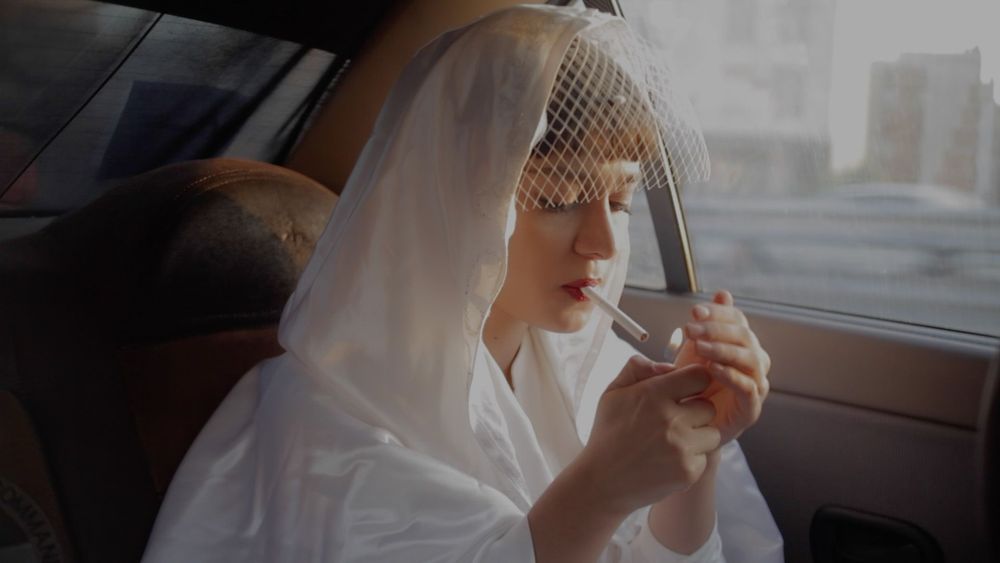
Tao HuiThe Dusk of Tehran transposes a speech given by the late Hong Kong popstar Anita Mui—who died in 2003 at the age of 40 from cervical cancer—into a conversation between a young Iranian actress and her taxi driver. Through this performance, the work juxtaposes the differences and shared struggles faced by women from different countries, portrayed within a single narrative frame.
Sight
Theo Jean CuthandDistinctive of Theo’s early DIY aesthetic, Sight is an experimental short that portrays the artist’s experience of visual impairment connected to living with schizophrenia and bipolar disorder. Filmed on Super 8, desaturated Saskatchewan landscapes are layered over with bright bands of purple, green, red, and blue. Coupled with Theo’s diaristic narration, the work blurs the boundaries between “sight” and “sanity.”
The Coast
Sohrab HuraFilmed in the dark of night during religious festivities in a South Indian village, the margin between land and water becomes a point of release, beyond which characters experience fear, surprise, anger, sadness, trust, anticipation, excitement, and contempt—but also rapture, as they wash off the masquerade in the waves. Sohrab Hura’s The Coast captures this trancelike sensory experience as part of a larger project reflecting on India’s social and cultural undercurrents.
You can’t get what you want but you can get me
Samira Elagoz, Z WalshThrough photos, screenshots of text messages, and an indie-rock/dream-pop soundtrack, Samira Elagoz and Z Walsh tell their story of falling in love, long-distance desire, marriage and families-in-law, and Z’s top surgery. You can’t get what you want but you can get me is an intimate document of queer/trans love, showing the transformative power of loving and being loved utterly and completely.
Grounds of Coherence #1, but this is the language we met in
Shen XinThrough speaking and sounding out in Mandarin Chinese, English, Arabic, Uyghur, Kindi, Kazakh, and Turkish, Shen Xin traces the experience of contemporary communication, seeking to uncover primordial connectedness in and through language. Thistwo-channel work—the first in the Grounds of Coherence series— explores ways of knowing, linguistic ecosystems, memory, and loss. The artist shows how language is a deeply embodied process that cannot be removed from experience of the natural world.
tabla dubb no.9
Hassan Khantabla dubb no. 9 treats a collective cultural product (a recited segment from alBurda, a poem charting the transfer through time of the prophet’s mantle chanted on the occasion of his birthday) and the structural qualities of video itself (the simple choice of how to shoot and arrange the visual material) as an attempt to produce forms that are culturally relevant and dangerously meaningful. The piece was originally produced as part of tabla dubb, a series of live music and video concerts that the artist performed in Egypt and abroad between 2001 and 2007.
But this is the language we met in
Communication is a mystified, mystifying, and highly engaged act…it is always, somewhere, absolutely clear and mysterious at one and the same time. And it is this cold heart I want to touch.
—Hassan Khan, “An Aesthetics of Survival” [1]
But this is the language we met in convenes six experimental shorts to explore the notion of transcendence as a political act. Drawing from contemporary art and experimental film, the diverse lineup comes together to contemplate how moving-image—as an embodied medium—allows us to transcend the limits of singular perspectives tied to geography, culture, and identity.
Borrowing its title from a 2023 work by Shen Xin, But this is the language we met proposes transcendence as a fertile meeting point: a space for being with instead of merely consuming culture, for nurturing relationships to knowledge rather than simply knowing, and for expanding the possibilities of how we communicate between cultures. Here, transcendence can be understood as a journey—blurring the boundaries between here, now, then, and there—and as an opening up, providing a passageway from one positionality to another. Various filmic techniques evoke transcendence: narrative devices of transposing and nonlinear storytelling; editing techniques of splicing, collaging, and superimposing; and structural approaches to framing, editing, and lighting.
By attuning to the various forms of personal and cultural transmission embedded within these six films, But this is the language we met in hones in on the powerful—and at times enigmatic—affective pathways within moving-image. Allowing us to see, hear, and even feel the world through the experiences of others, these works offer departure points from prior states of individuation, and ways coming together constellationally, in and through our differences.
- https://openspace.sfmoma.org/2020/01/an-aesthetics-of-survival/
2 Sussex Ave, Toronto, ON M5S 1J5
Please note that for entry to Innis Town Hall, Sussex Drive is closed and inaccessible by car. The sidewalk is open and the entrance remains open. Sidewalk-level entrance, elevator and ramp available, door width 32 inches, no automatic doors. No accessible parking on-site. Four wheelchair accessible seats in the cinema. 15 step-free seats in row 9. Accessible gender-neutral washroom located on the 2nd and 3rd floor.
For a map to Innis Town Hall, click here
(ARTISTS)